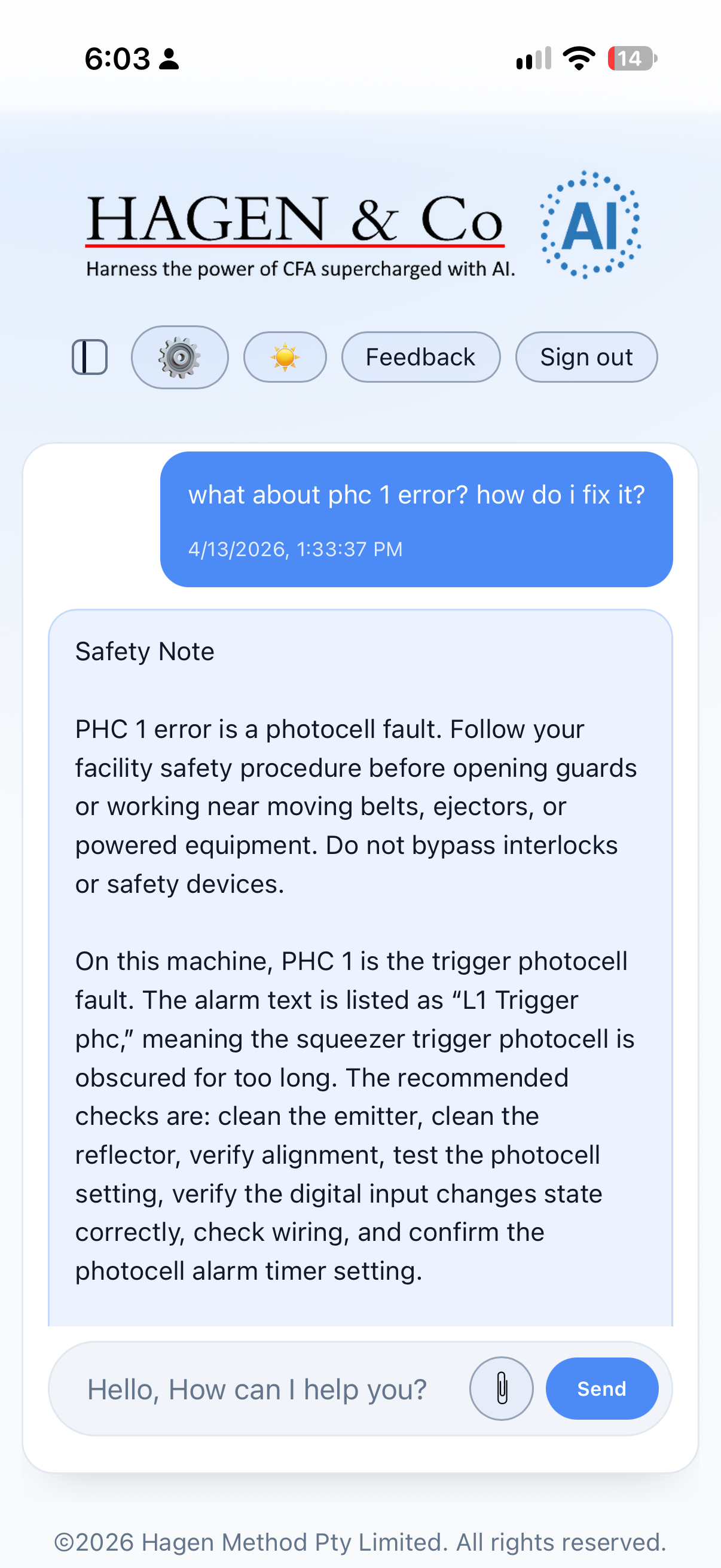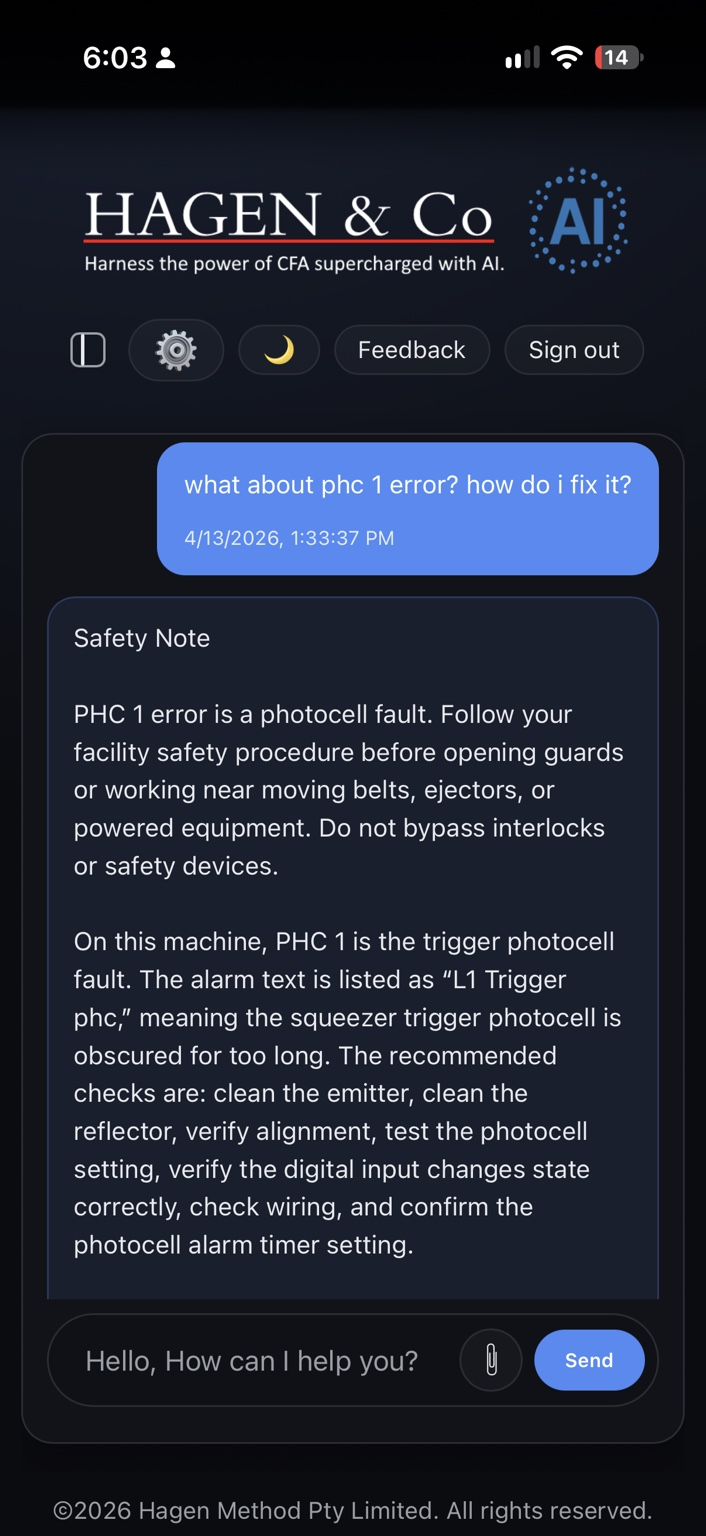

Put manufacturing expertise on every shift.
Help your operators, mechanics and engineers understand difficult problems and know what to investigate next.
Engineering guidance, Hagen’s proven methods and production analysis, informed by your plant’s knowledge.
Built by the people solving manufacturing problems.

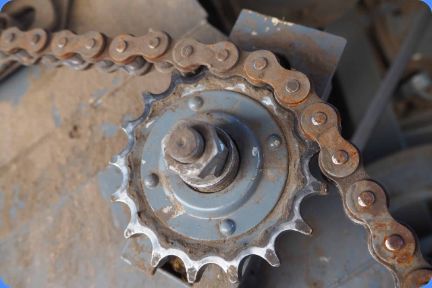
Your team: What is wrong with this sprocket? What is causing this?
Photo of a worn sprocket and chain.
Hagen AI · Safety first: Before inspection, isolate energy and follow your facility’s lockout/tagout procedures. Never inspect the chain or sprocket while it is moving.
Hagen AI: The sprocket teeth are severely worn and “hooked”. A worn or elongated chain can concentrate contact at the tooth tips and accelerate this wear.
Next check: Measure chain elongation against the manufacturer’s specification. To explore the cause further, use CFA to examine chain tension, alignment, lubrication and loading.
Less time searching for answers.
A clearer way to investigate.
More knowledge within your team’s reach.
Already at work
Experience from
manufacturing teams.
Reported by Hagen for teams using Hagen AI with the Hagen Method to solve priority problems.
reported CFA completion time for selected complex investigations
Inside a real CFA investigation
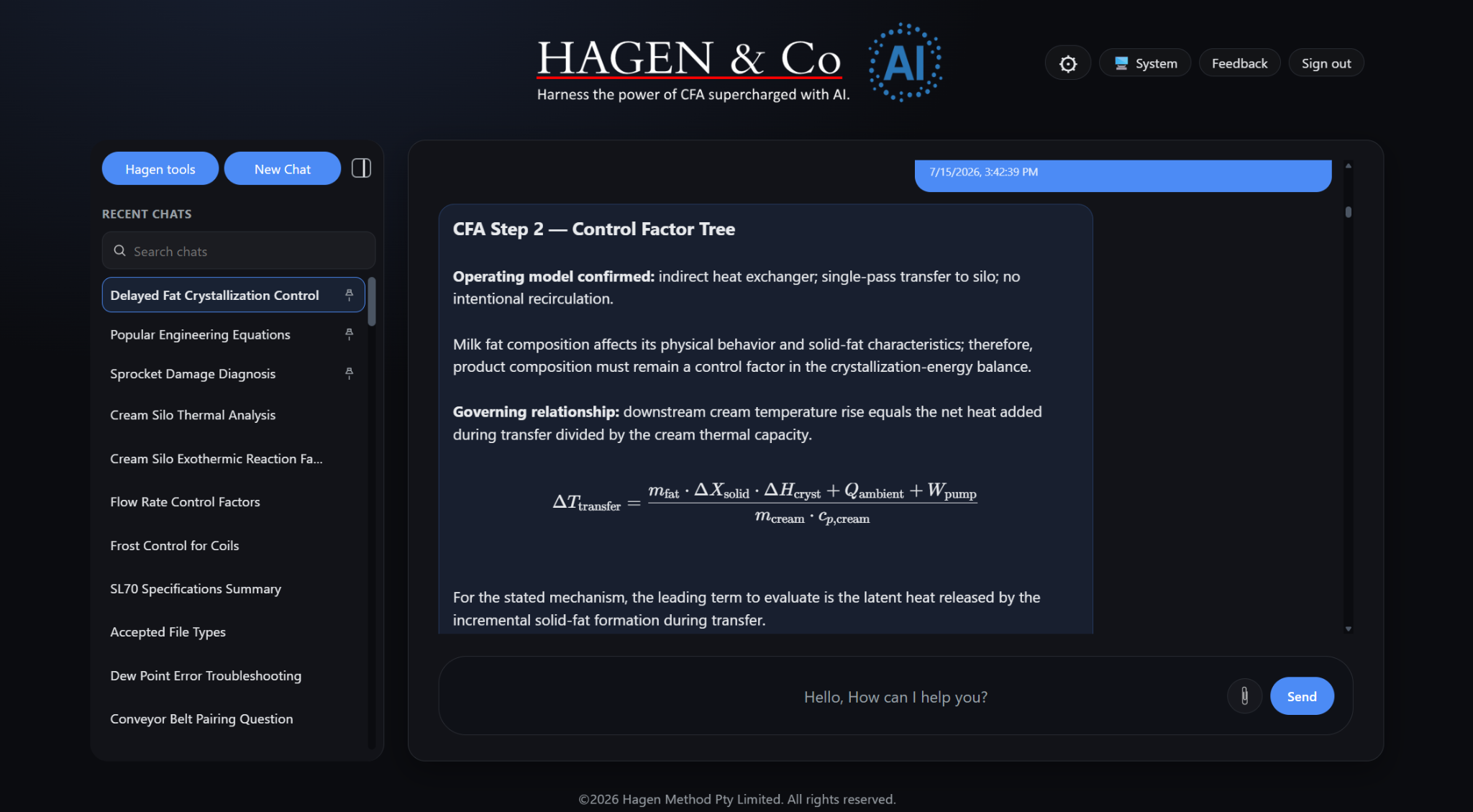
Why was the product getting warmer after cooling?
A dairy product’s temperature rose beyond specification after cooling, transfer and storage. Hagen AI helped the team use CFA to investigate a mechanism that had been overlooked during the system’s design and installation.
Latent heat released within the product.
CFA connected the product’s physical behavior with heat gained in transfer and storage—and the cooling capacity needed to keep it under control.
Conceptual animation: milk fat continues to crystallize after cooling, releasing latent heat. That heat adds to the heat-removal duty. This illustrates the physical mechanism, not a measured temperature trace.

CFA Tree Builder
Cream-temperature investigationFollow the CFA investigation
From a symptom to a cause-and-effect explanation
CFA made the full heat balance visible.
The cream left the cooler at approximately 2 °C, yet reached 9–10 °C in the silo against a target below 4 °C. CFA separated the starting temperature, the heat entering or released within the product, and the heat the cooling system could remove.
Hagen AI helped examine the engineering behind each control factor. The investigation connected delayed milk-fat crystallization with heat gain through the transfer pipe and the warm silo after cleaning. The existing jacket could not offset that combined load.
Supposed behavior. Real behavior. Evidence.
- Define the parameter. Establish the temperature target and trace when the rise occurs.
- Develop the control factors. Start from conservation of energy, including the heat released as milk fat crystallizes.
- Test the explanation. Compare observations, the bypass test and engineering references with the cause-and-effect statement.
- Connect the actions. Evaluate insulation, cooling capacity and the additional heat-removal duty identified by the CFA.
The engineering principleTemperature rise follows net heat added relative to the product’s thermal capacity.m cp ΔT = Qin + Qcrystallization − Qremoved
Technical reference: Tetra Pak’s Dairy Processing Handbook · The chemistry of milk ↗ explains heat released during fat crystallization.
The Hagen AI workspace
Support for the problem.
Tools for the work.
Explore the engineering guidance, company knowledge and analytical tools your team can bring into an investigation.
Expertise within reach
A stronger starting point for your next investigation.
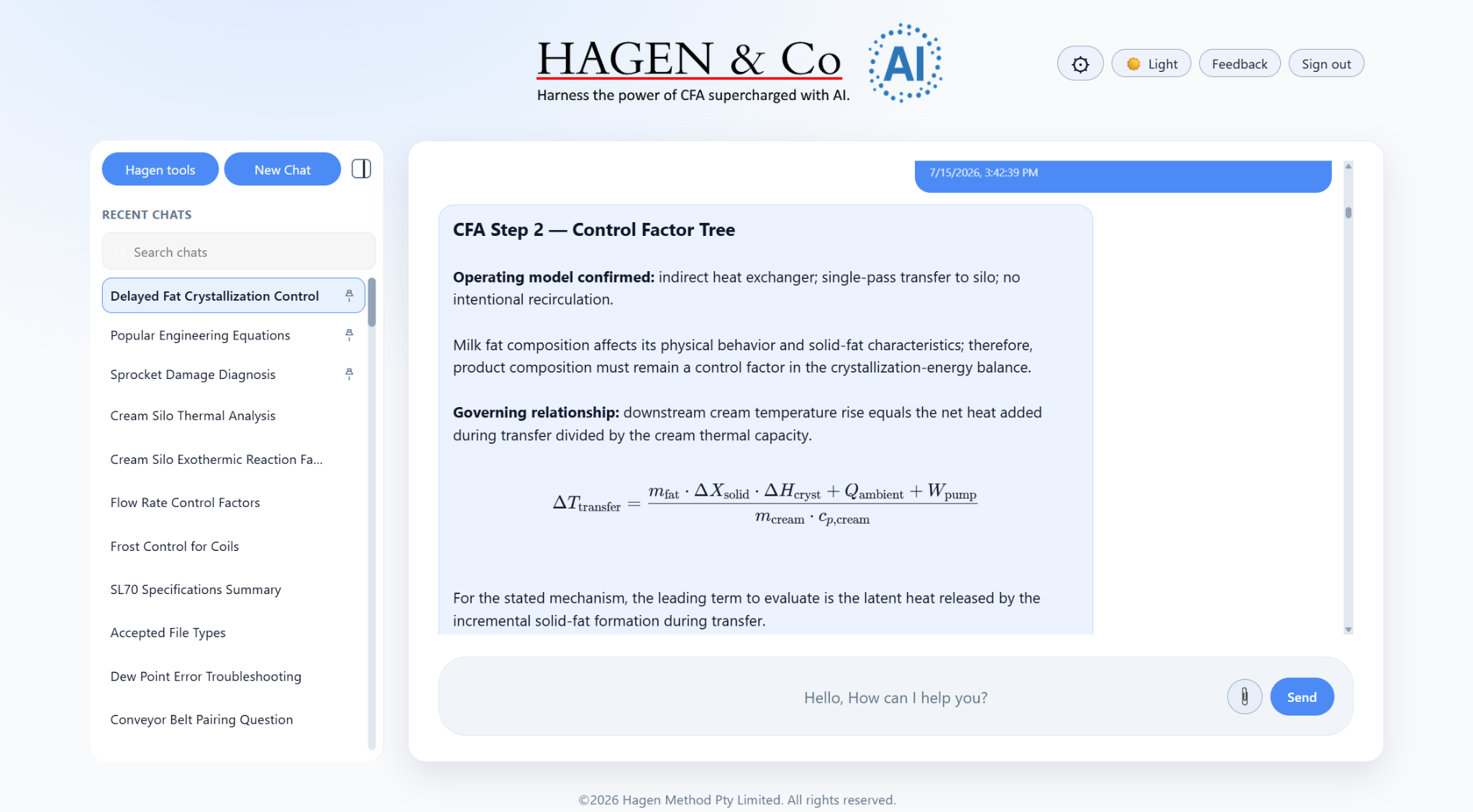
Bring engineering reasoning to the problems that interrupt production. Hagen AI helps your team understand how a system should work, examine what changed and decide what evidence to collect.
- Explore equipment, processes, materials and controls through first principles, working principles and engineering equations.
- Connect photos, technical documents, supported PLC files and operator observations to the problem.
Built with safety in mind, with safe access and operating conditions considered before physical investigation.
Answers in your operating context
Less time searching. More time understanding.
Bring machine manuals, SOPs, specifications and your own improvement methods into the investigation. Retrieve relevant information from the documents configured for your team.
- Ask questions about long technical documents in everyday language.
- Work across languages so teams can use knowledge from other sites.
Document retrieval brings relevant source material into the answer without training the underlying model on your data.
After a film-roll change, print registration drifts. What should we check before adjusting the sensor?
- Confirm the film specification, print repeat and selected machine recipe.
- Compare the web path, splice condition and tension settings with the approved setup.
- Check the registration-mark signal against the encoder trend before changing sensor position.
Use approved safe access and isolation procedures. Record when the drift begins and compare it with the splice passing through the machine.
View the supporting passage
Film-roll changeover SOP · §6.3
“Before sensor adjustment, verify the film specification, print repeat, recipe, web path, splice and approved tension settings. Compare the registration-mark signal with the encoder trend. Follow safe access and isolation procedures.”
Fictional SOP and example answer illustrating document retrieval.
The Hagen Method in the work
Give every shift a repeatable way to solve problems.
Combine AI’s technical reach with the discipline of Control Factor Analysis®. Investigate difficult failures, analyze photos and explore the working principles behind each control factor.
- Connect PLC logic, trends, photos and failure evidence to supposed and real behavior in the CFA tree.
- Keep the tree, evidence and supporting documents together in the CFA Library, ready for the next investigation.
Bring relevant past CFAs into the conversation so the AI can reason with your team’s accumulated knowledge and operating context.
Example investigation · Fill-weight variationTree, evidence and supporting files stay connected for future investigations.
Illustrated workflow based on an anonymized fill-weight CFA, not a verbatim app transcript. One continuous conversation leads into tree building. Earlier messages remain available by scrolling within the conversation. Use Pause and the previous and next stage buttons to explore at your own pace.
Purpose-built manufacturing tools
See the losses. Focus the improvement.
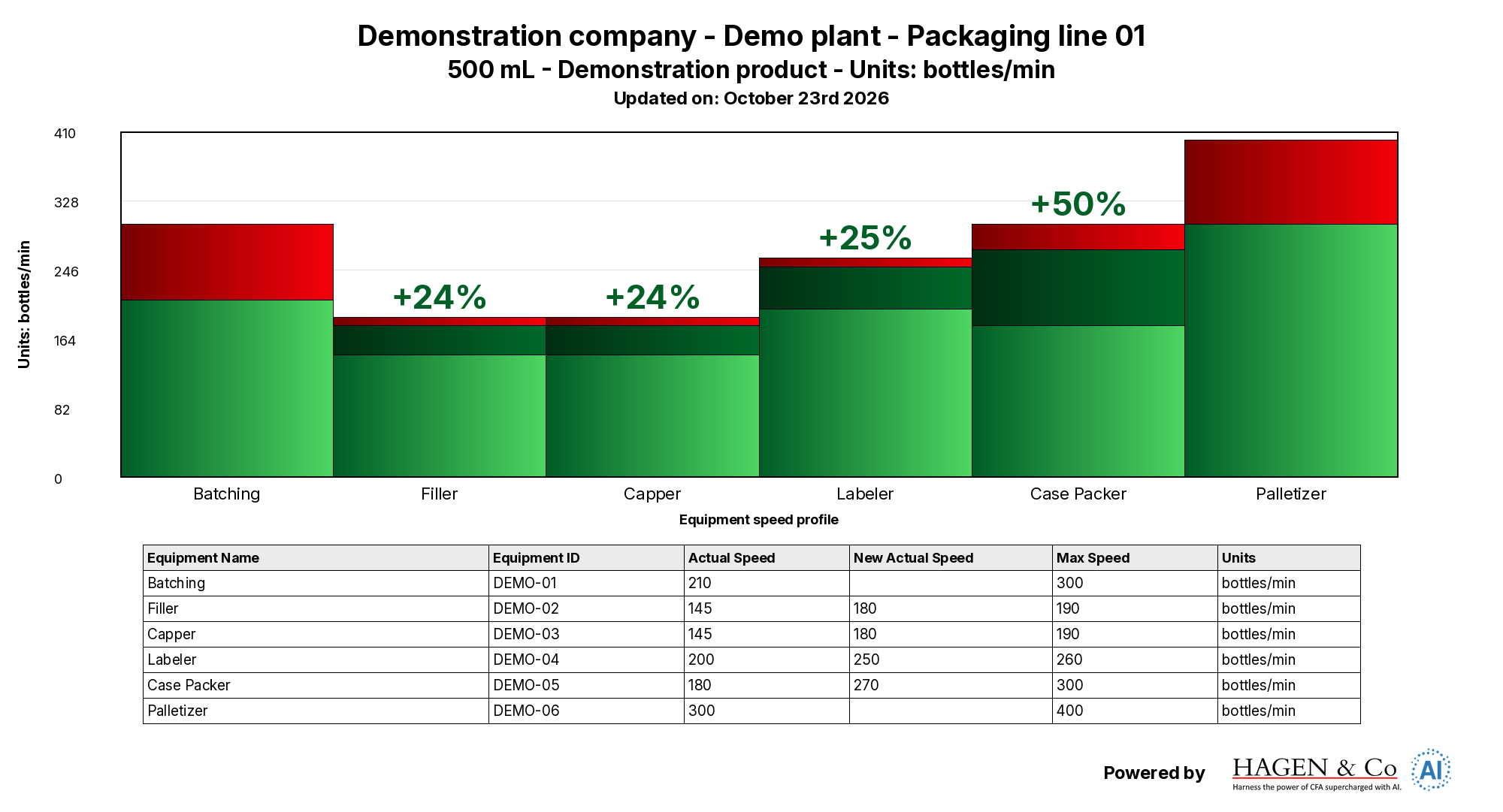
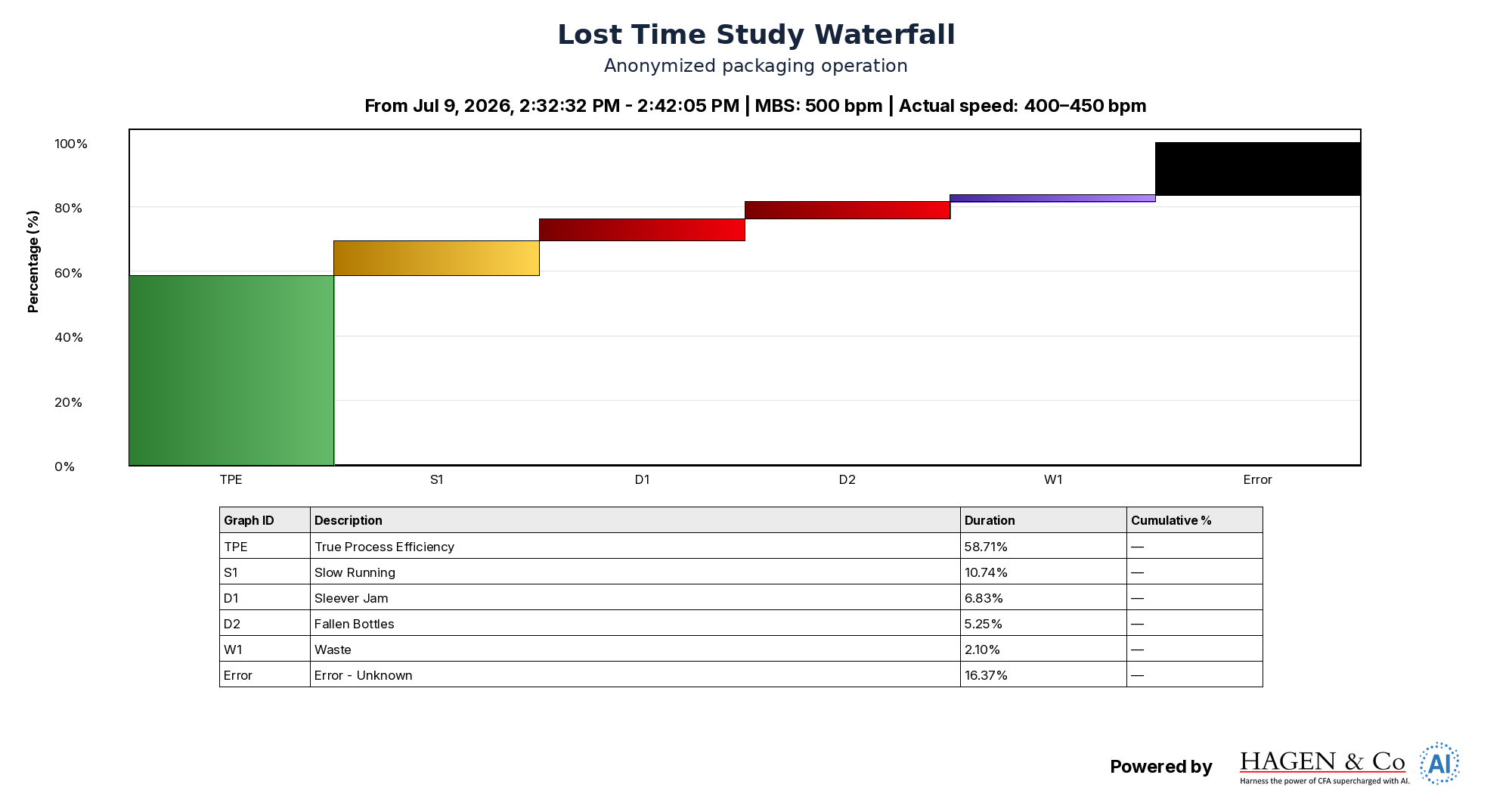
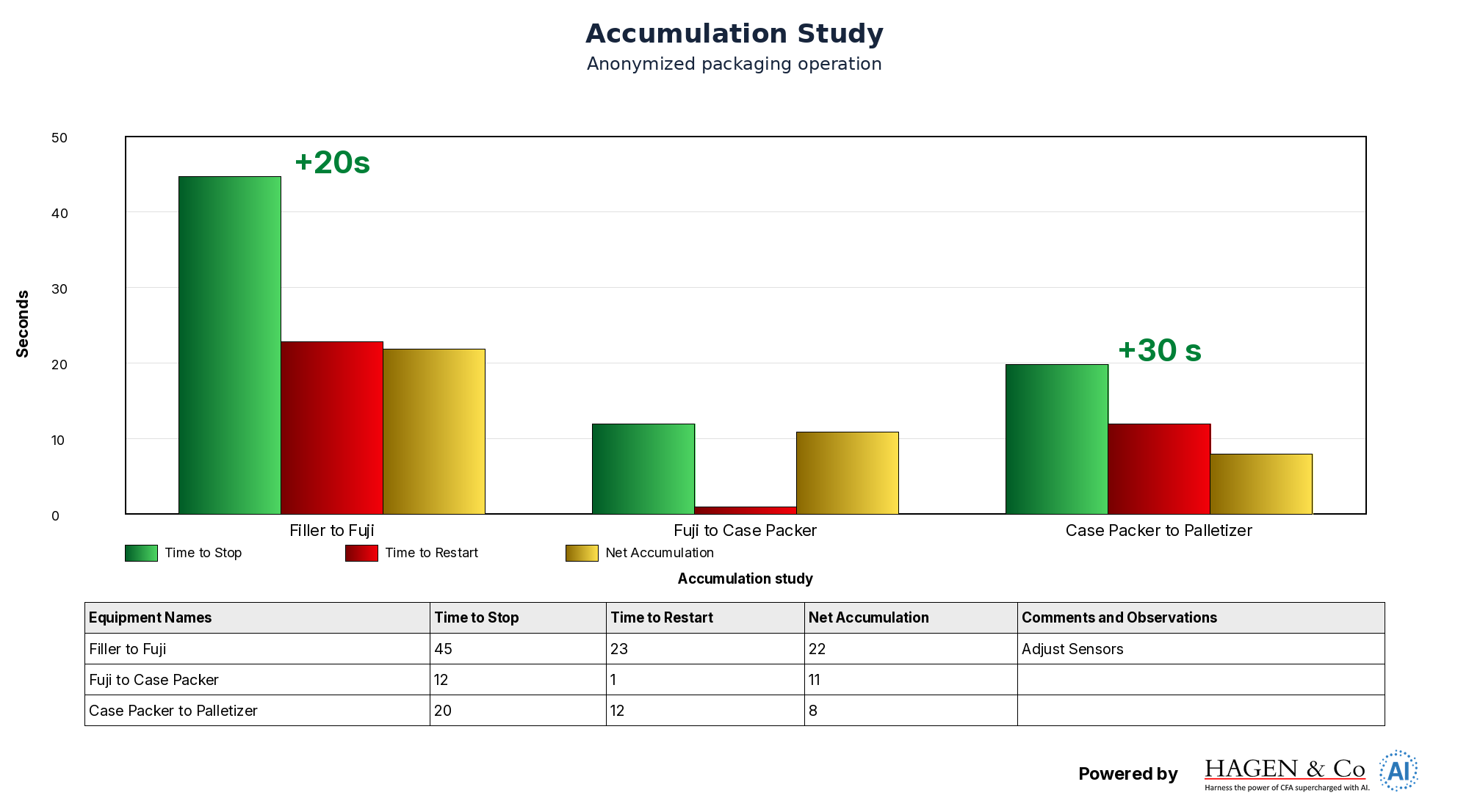
Put the Hagen Method to work on your production data. Hagen AI handles the analysis and creates clear outputs, without long spreadsheets or hours of Excel preparation—like an expert consultant in your pocket.
- Identify losses across speed, stops, waste and equipment interactions, using tools built around the Hagen Method.
- Custom tools can be developed to take in data from RedZone or other collection systems and apply the same analytical methods.
Explore selected tool exports. Save the analysis, share the evidence and return to it as the work develops.
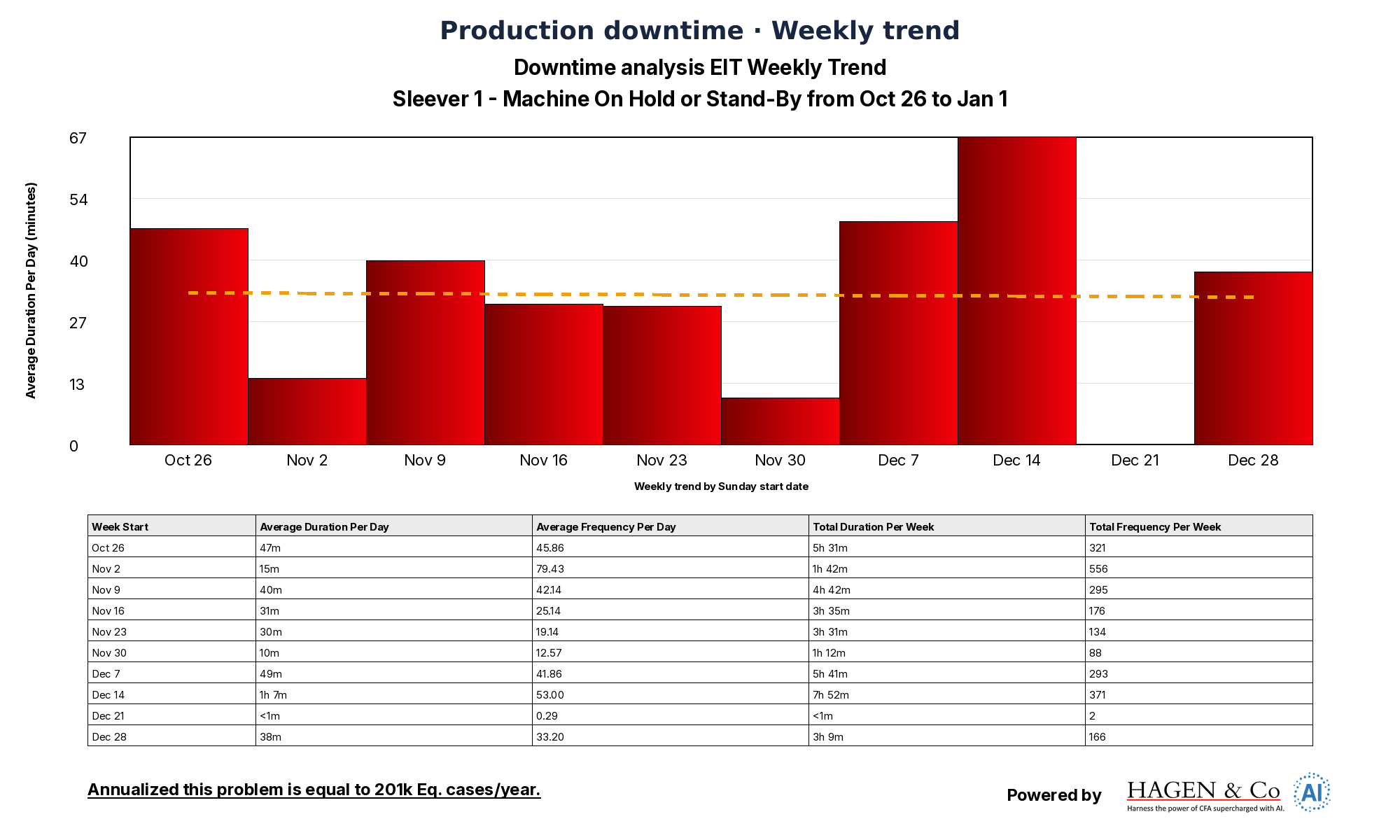
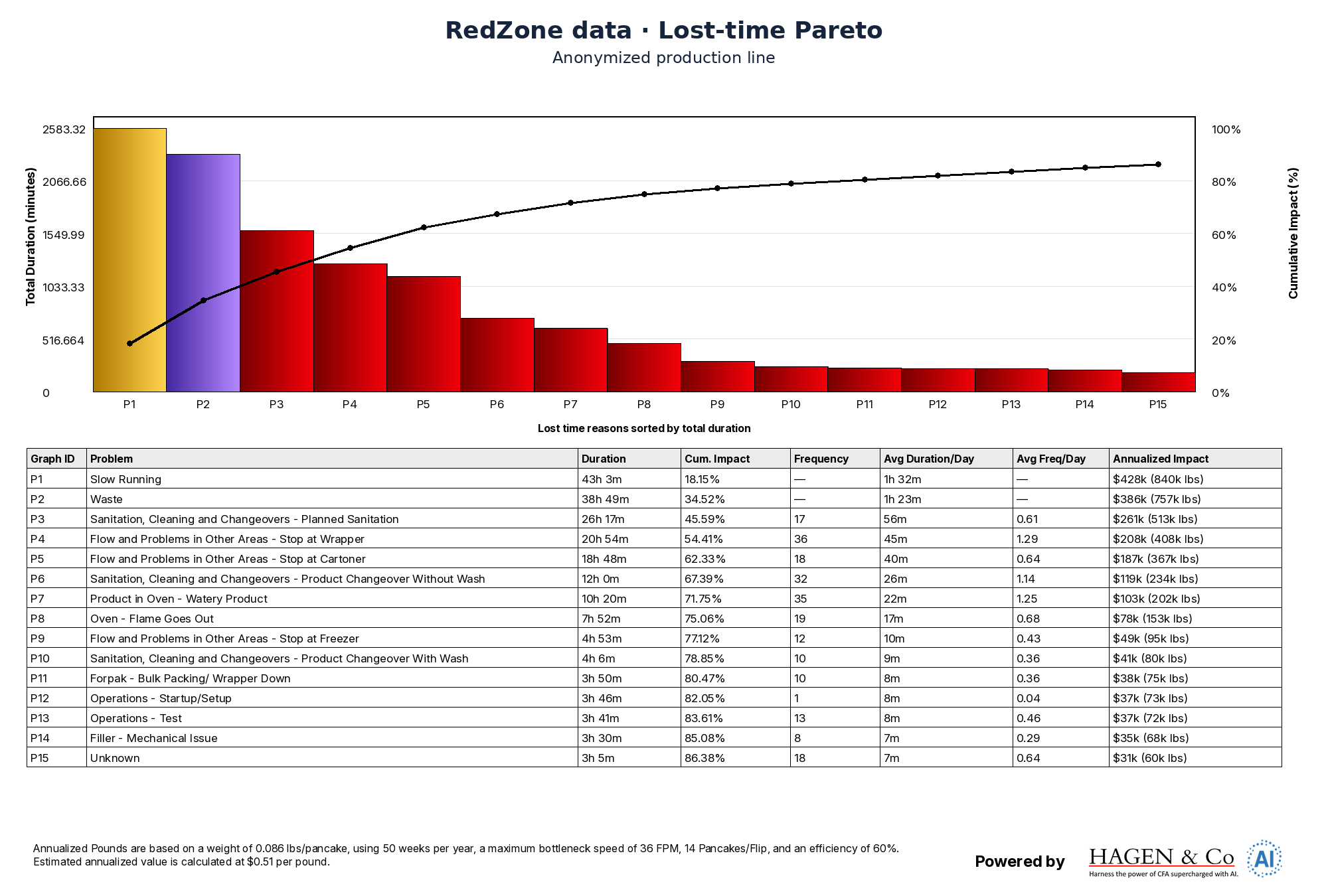
Built around your operation
Your knowledge.
Your people.
Your control.
Configure Hagen AI for your operating context, with controlled access to company information and training to help your teams use it well.
- Authorized access
- Encrypted data handling
- No model training with your data
Can Hagen AI work with our documents and methods?
Yes. Hagen AI can be configured around your machine manuals, SOPs, specifications and Continuous Improvement methods. Retrieval-augmented generation (RAG) brings relevant passages from the documents available to your team into the conversation. Your own operating context informs the guidance.
Is our data used to train AI models?
No. Your company data, conversations and uploaded documents are not used to train the underlying AI models. Using your documents to inform an answer is separate from model training.
Who can access our information?
Only authorized users can access your information. Access is scoped to your company and plant, with role-based permissions and administration. Data is encrypted in transit and in storage, and passwords are stored as hashes rather than plain text.
How are uploaded files and conversation history handled?
Uploaded files are transferred securely to the AI processor rather than stored on Hagen servers. Temporary uploaded files are automatically deleted after 30 days and can be deleted on request. Hagen retains conversation history and file references for operational needs; deletion is available on request. When a user is removed, their history and logs are deleted.
Can we investigate PLC logic and reuse past CFAs?
Yes. Supported PLC files, including L5X exports, can help the team examine logic and debug a problem as part of a CFA. Connect those files to trends, photos and other evidence in the CFA Library. Relevant documented investigations can then inform later AI conversations, giving the guidance more of your operating context. Any control-system changes remain subject to your engineering review and site procedures.
How do we help our people get started?
Hagen provides CFA and AI training for your people and can configure the platform around your operating context. Teams can access Hagen AI on desktop and phone, with multilingual support for questions and technical material. Request a demonstration to discuss your sites, documents and improvement priorities.
See Hagen AI work through a manufacturing problem.
Explore how engineering guidance, your plant knowledge and the Hagen Method can support your team.